


6 Ways to Help You Create Unity in Your Artwork for Exhibition - Becoming a Professional Artist 3
Updated: Jun 10, 2019
As we have already discussed in a previous blog, you have started to narrow your focus & are now looking to create cohesion (unity) in the artwork you are getting ready to exhibit.
One way discussed was your choice of subject matter. For example, landscapes, portraits, animals, flowers or abstracts.
But what are the other ways that you can use, to create cohesion in your work for your first solo exhibition, so that your work is perceived to be professional?
You may create cohesion via the medium you use.
For example all your work is painted in acrylic, watercolours or oils or you draw in pencil, pen, ink or charcoal or sculpt in clay,limestone or marble, photograph in black & white or create with fibre.
If, however, like me, you are a mixed media artist, who likes to create with a variety of mediums & subject matter, how do you bring all your work together into a cohesive body of work for exhibition?
One way, is with your style of artwork.
Is your style of work realism (painting subjects as they appear in ‘real life’), Impressionism (capturing the impression of the light of the subject), abstract expressionism (spontaneous use of colour to express the unconscious) or one of the many other ‘isms’ in art? Keeping to one style of work creates a cohesive exhibition.
You may also have cohesion by the theme of your artworks.
For example, all of your paintings express the calm of the morning light, the awesome ocean, aged faces or an abstracted feeling. The title or name of your exhibition will express this theme too.
For example,
Subject Theme Possible Exhibition Name
Landscapes Calm of the morning light ‘Morning’s Grace’
Seascapes Awesome ocean ‘Ocean’s Fury’
Portraits Aged faces ‘Time Marches On’
Abstracts Peace. 'A Quiet Day’
If you’re having trouble with your exhibition name or the titles of your artworks, pull out the Thesaurus (it's available online too) and look for synonyms, think about how you were feeling when you created the artwork (it's handy to keep an artjournal or a written journal, making notes as you go).
Just remember, ‘Untitled Number so and so’ is annoying to the public (no yelling from the abstract expressionists please, who say they want their work to speak for itself, the public want to know what you were thinking or feeling when you created your work😁).
The colours you choose for your palette is another way to bring unity to your exhibition.
For example, like Picasso, you could be having a ‘Blue Period’ where all your work is in different tones of blue or perhaps your work is all in black & white or you paint all your work with the same triad of colours or all of your drawings are on sepia paper. By limiting your palette you will bring unity to your exhibition.

But again, what if, like me, your subject matter, mediums & palette is diverse or perhaps you’re not sure of your style?
How do you bring unity to your exhibition?
You bring unity through the presentation of your artwork.
That is, with the style & shape of the canvas you use, with the the framing of your artwork, with the way your artwork will be displayed.
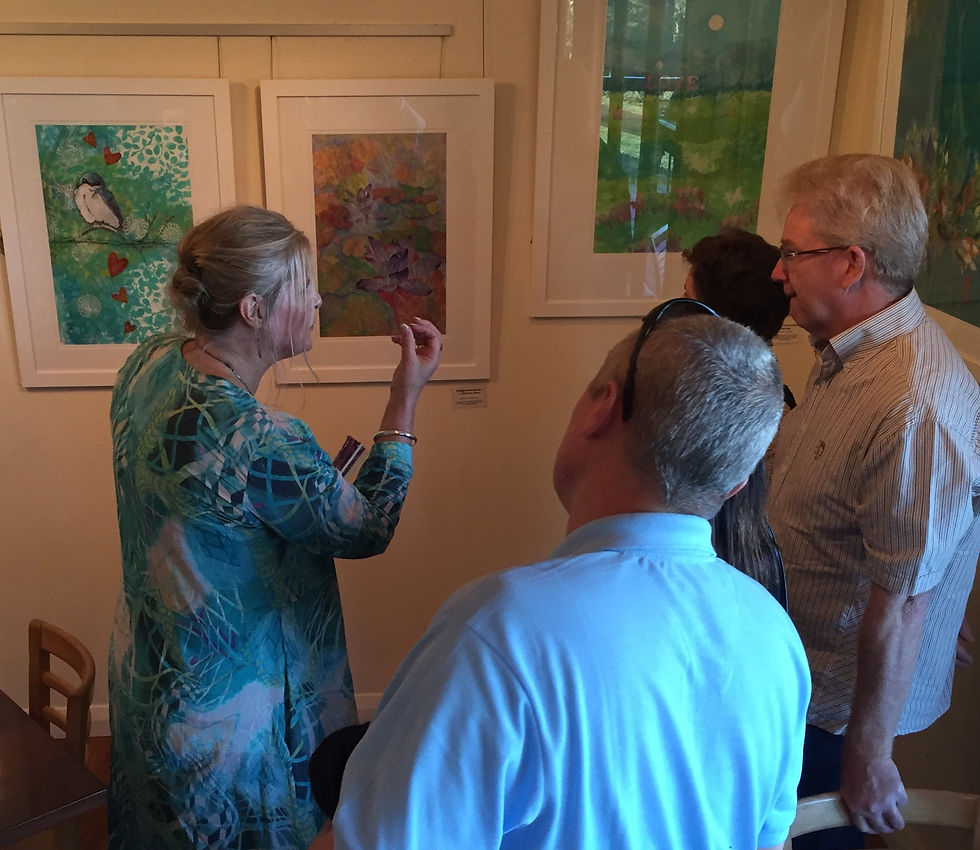
I use a diverse number of mediums & subjects in my mixed media art, so I paint or mount my work on watercolour paper & frame all of my work with white double mat boards, set under glass with white wooden frames.
By using this method of framing, my large ink & watercolours on yupo paper stand comfortably next to my small fibre artworks or my acrylics on paper, and my exhibition looks cohesive and professional.

Now, what if you've already created your works of art on all different size canvases, paper etc how do you unite them for your exhibition?
Again, unity is created by how you frame your work or display it.
Pick just one style of frame/display, not a mishmash (there's that technical term again😁) of different frames/display, so it will tie your work together.
A couple of things to remember.
If painting on canvas, choose the deep sided canvases (they are a little more expensive at first but you’ll save money in the long run). Art galleries expect all other canvas boards & thin sided canvases to be framed whereas if you use the deep sided canvases you can simply add your D-rings and chord and they are ready to hang (more on this in my next blog).
Watercolours, pastels, charcoal, ink or works on paper must be framed under glass with a mount (the mount prevents the glass coming in to contact with your artwork). In a later blog I’ll show you the trick of how to mount works on paper on wooden boards with acrylic mediums, saving you 100’s of dollars in framing costs.
So remember, you don’t have to have all 6 of these concepts to create unity but the more you have, the more professional, cohesive and united your exhibition will look.
Good luck!
In my next blog, we’ll talk about the ins and outs, do and don’ts of framing, canvases and how to actually hang your paintings in the exhibiton space for your first exhibition as a professional artist!
❤️✨

Comments